How to Explore the Forbidden City — All 100 Football Fields of It
I’ve lived in Beijing for over twenty years, and it wasn’t until recently that a thought hit me — I’d never actually been inside the Forbidden City. This ancient palace, the one every visitor to Beijing puts at the top of their list, I’d walked past it more times than I could count, and never once bought a ticket. I pulled up the WeChat mini-program to book, and that’s when I found out — the earliest available date was a week out. That’s when I truly understood how hard these tickets are to get.
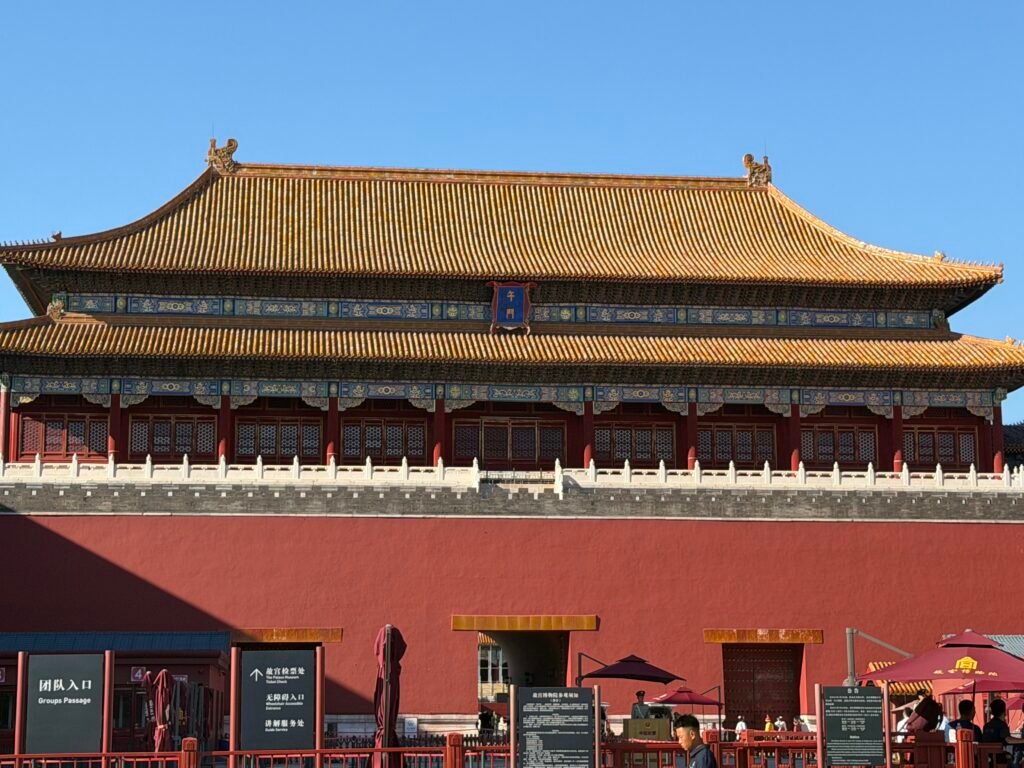
A week later, on a Wednesday, I got up early and took the subway to the Forbidden City. The line had already formed before I even reached the entrance, and the security checkpoint queue looped around several times.
Finally through. As I stepped through the tunnel of the Meridian Gate, light suddenly flooded in — I came out squinting.
The square in front of the Hall of Supreme Harmony was bigger than I’d imagined. Grey stone slabs stretched out until they disappeared into the distance, ending at the Gate of Supreme Harmony, then the Golden Water Bridge, and only past that did the Hall of Supreme Harmony finally show its roofline. The square was already packed — tour guides holding up little flags, visitors with phones raised, and a few girls in hanfu posing for photos, their red skirts standing out sharply against the grey stone.


It was 10:30, the sun was out, and I’d figured I had the whole day. But looking out over that square with no visible end, it hit me for the first time — I might not even get through a tenth of this place.

I looked it up later, and realized “100 football fields” was really just my own back-of-the-envelope way of putting it. The Forbidden City covers 720,000 square meters, and over 85% of it is open to visitors. Do the math against a standard football field (7,140 square meters) and you get more than 80 of them laid out in front of you. I could only be grateful I’d worn comfortable shoes that day.
From the Meridian Gate to the Gate of Divine Might, the straight-line distance is 961 meters — under a kilometer. It looks short on paper. I found out fast that no one actually walks in a straight line here.
Through the Center: Three Halls, One Garden
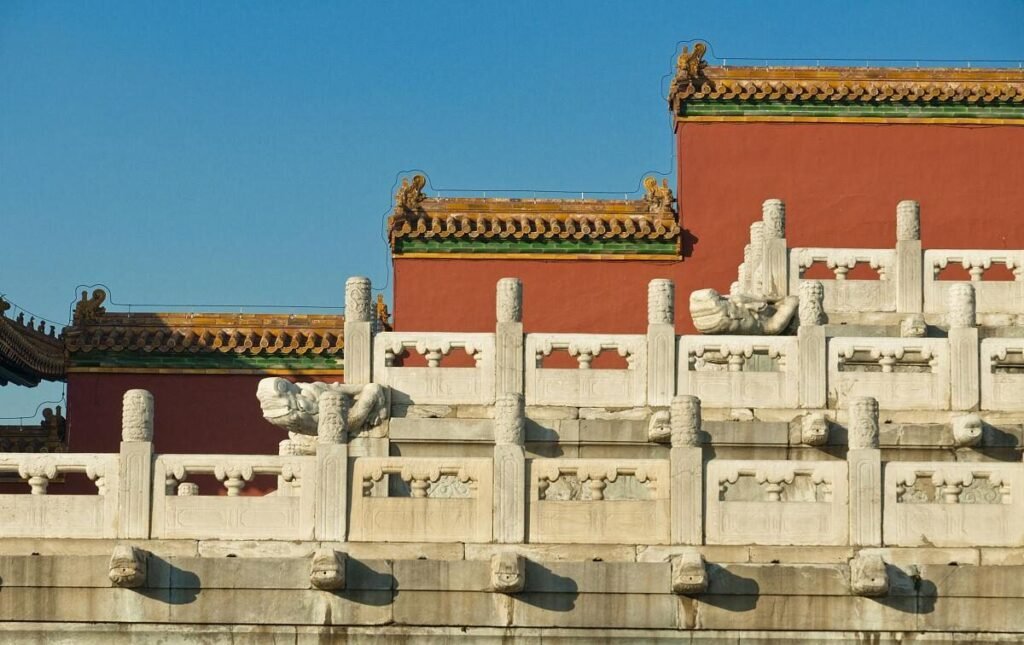
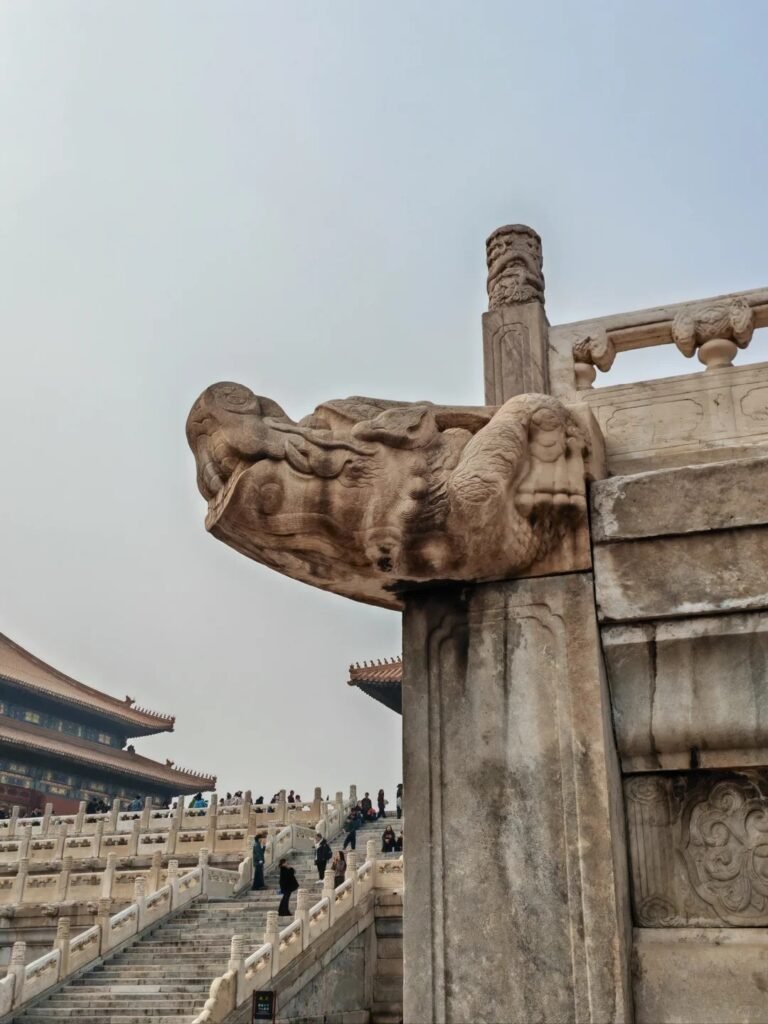
Past the Gate of Supreme Harmony, I finally stood at the edge of the square in front of the Hall of Supreme Harmony itself. Up close, it was bigger than it had looked from the gate — almost too big to be real. It sits on a three-tiered marble platform, over eight meters high, gleaming white, shaped like the Chinese character for “earth.” Stone balustrades run the length of it, and beneath each post juts a carved dragon head — supposedly over a thousand of them ring the platform. When it rains, water pours out of their mouths, an effect known as “a thousand dragons spitting water.” It was sunny that day, so I didn’t get to see it. But just standing beneath the platform and looking up, I already felt like the hall was looking down on me.

Leaving the Hall of Supreme Harmony, I continued north along the central axis. The Hall of Central Harmony and the Hall of Preserving Harmony slipped past — I didn’t go in, just circled each one from outside. Past the Gate of Heavenly Purity, the whole feeling of the place shifted. Around the Hall of Supreme Harmony, everything had been open, exposed, making you feel small. North of the gate, the space narrows, the walkways shorten — like stepping from someone’s public face into their private one.
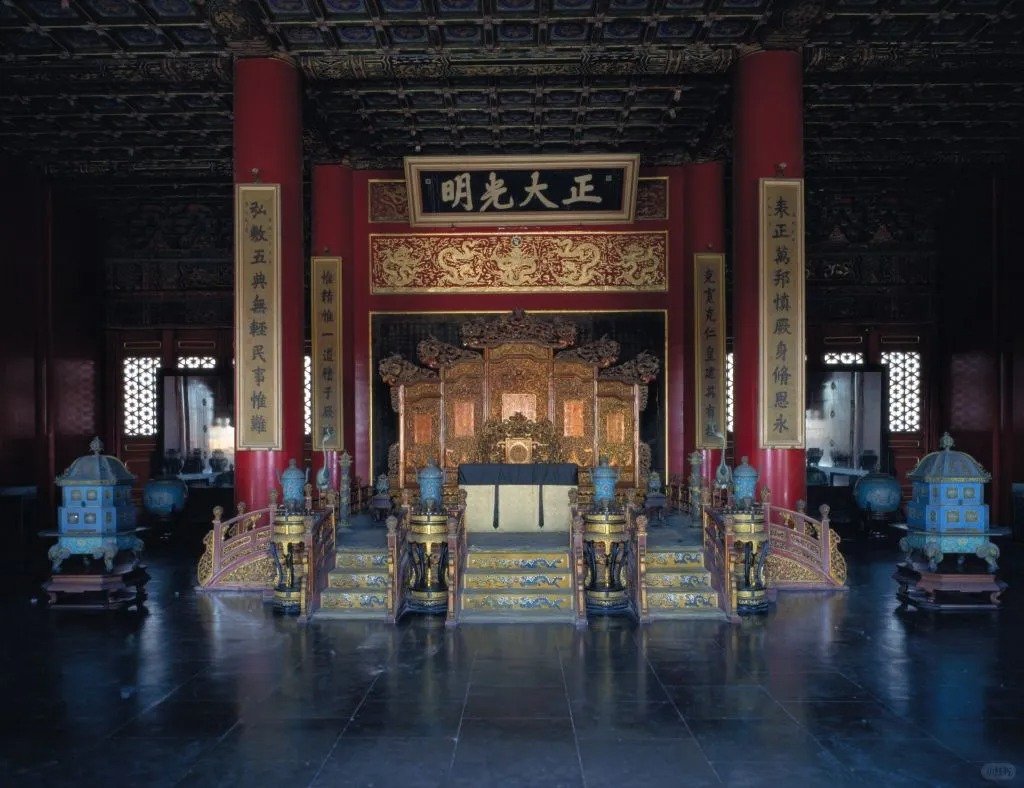
The doors of the Palace of Heavenly Purity were open too. Standing at the threshold, the first thing I saw was the plaque.
Zheng Da Guang Ming — “Upright and Illustrious” — hangs directly above the throne, black lettering on gold, the color gone deep and heavy, as if it had spent centuries soaking up the light in this room
The Imperial Garden. My first reaction wasn’t that it was small — it isn’t, not really — it was that the green felt so sudden. Everything up to that point had been red walls and yellow tiles; then all at once the color changed completely. Trees overhead, gravel underfoot, wisteria climbing the walls, and the air suddenly damp with the smell of soil and leaves.
At the center sits the Hall of Imperial Peace, which I circled without going in. On either side, two pavilions face each other across the garden — Wanchun Pavilion to the east, Qianqiu Pavilion to the west, built almost identically, distinguishable only by the color of their painted ceiling coffers: red flame motifs on one, blue on the other.
Looking down, I noticed the path itself wasn’t ordinary gravel — it was a mosaic, five-colored pebbles set into brick-carved frames, forming pictures. I crouched to look at one section and made out two figures sitting beneath a tree, a deer beside them — I never learned what story it told. I followed the path east, the pattern shifting underfoot every few steps, like reading a picture book laid flat on the ground.


The Half of the Forbidden City Most People Never See
There are two more places worth going out of your way for: the Clock and Watch Gallery, and the Gallery of Treasures.
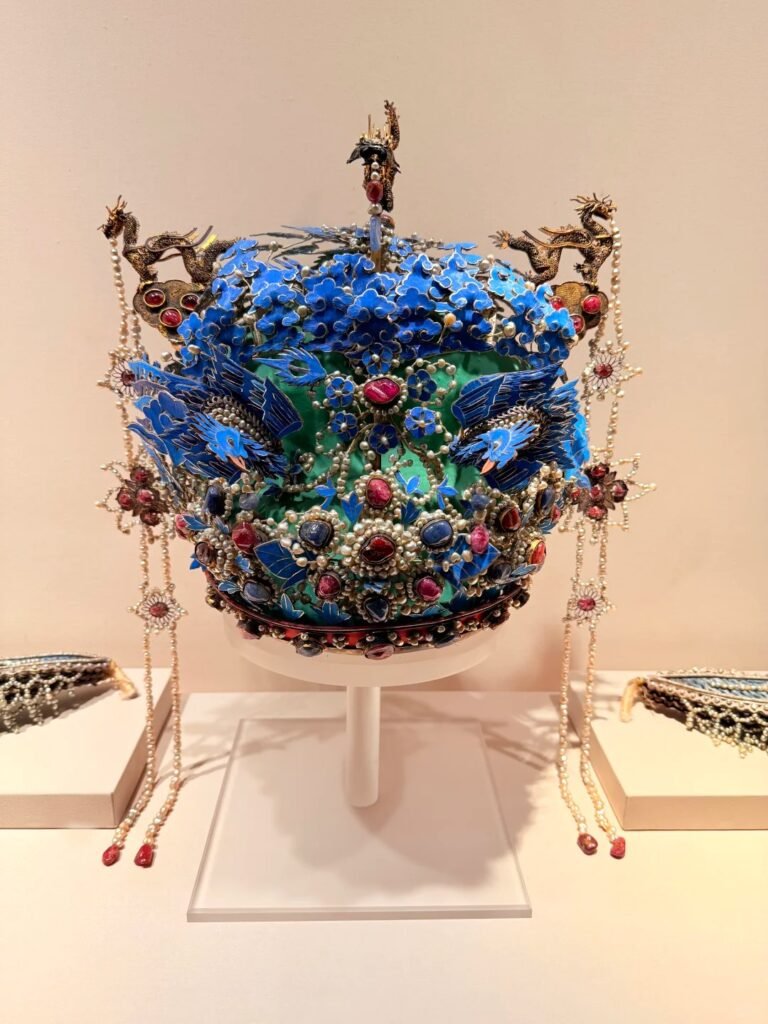
The Gallery of Treasures is in the Ningshou Palace complex, in the northeast corner of the Forbidden City — the retirement palace Qianlong built for himself, echoing the central axis layout on a smaller scale, but with even finer materials and detail. Inside are gold and silver ware, jade, ivory carvings, jadeite, cloisonné — all from the imperial collection, lit up in glass cases so bright it’s almost dazzling. One piece stopped me: a jade mountain carving over two meters tall, depicting Yu the Great taming the floods, cut from a single block of jade into peaks and cliffs crowded with tiny figures quarrying stone — every one of them caught mid-motion. The jade traveled from Xinjiang to Beijing, then to Yangzhou to be carved, then back to Beijing again — the whole process took over a decade. Admission here is also ten yuan.
The Clock and Watch Gallery sits inside Fengxian Hall, originally the private temple where Qing emperors made offerings to their ancestors. Today it holds more than eighty Western clocks from the imperial collection, most of them from Britain, France, and Switzerland — objects that crossed the ocean centuries ago. There’s a gilt-bronze clock with a mechanical figure that writes characters, a rooster-topped clock that crows on the hour, one shaped like a hot air balloon. On the hour, some of them move, some of them chime. The Qianlong Emperor collected these as toys as much as treasures. Admission is a separate ten-yuan ticket, and the entrance is just east of the Gate of Heavenly Purity.

A few things to know first
- Closed on Mondays:The Forbidden City is closed every Monday (except on Chinese public holidays) — plan your itinerary around this.
- Prohibited items:Lighters, knives, large tripods, and selfie sticks over 1 meter aren’t allowed through security. Sunscreen spray and drinking water are fine to bring in, but eating and drinking aren’t permitted inside the exhibition halls.
- Payment:Shops and restaurants inside accept Alipay and WeChat Pay. It’s worth linking an international card to these apps ahead of time, or carrying some cash, since some smaller vendors don’t take foreign cards directly.
- Sun and wind:There’s little shade inside the complex — bring plenty of water and sun protection in summer, and dress warm for the wind in winter.
Getting there & getting in
The Forbidden City sits right by Tiananmen Square, and it draws huge crowds — so booking, tickets, and security are all things worth sorting out ahead of time. Here’s what I wish I’d known before I went.
Booking & Buying Tickets
- Book ahead:The Forbidden City does not sell same-day tickets. Tickets are released exactly 7 days in advance, every evening at 8:00 PM Beijing time. During peak season (May–October) and Chinese public holidays, tickets go fast — set an alarm and be ready the moment they drop.
- Official English channel:For foreign visitors, the easiest option is the Palace Museum’s official English website (dpm.org.cn). It has a fully English interface, accepts international cards (Visa/Mastercard), and is the smoothest way to enter your passport details.
- WeChat mini-program (alternative):You can also search “故宫博物院” (Palace Museum) on WeChat. When adding a visitor, select “Passport” as the ID type, and enter your name and passport number exactly as they appear on your passport — no discrepancies allowed.
- On-site standby tickets:If you couldn’t book online, some foreign visitors have managed to buy a same-day ticket at the manual counter at the Meridian Gate with their original passport — but this depends entirely on that day’s leftover quota. During peak season it’s very unlikely to work, so booking online in advance is strongly recommended.
- Free tickets for foreign children:Children aged 0–6 (foreign nationals) enter free, but still need to be booked in advance. Note: the WeChat mini-program may not accept a child’s passport number for the free ticket — in that case, use the English official website instead, or just book a full adult ticket to avoid holding up your entry.
ID & Security
- Bring your original passport:Entry is tied to your booking via real-name verification. A photo, photocopy, or digital scan of your passport will not be accepted — only the original document.
- Use the manual lane:The e-gates occasionally have trouble reading foreign passports. Once you reach the Meridian Gate, it’s usually faster and smoother to head straight for the manual staff lane and show your passport and booking confirmation there.
- Tiananmen Square security check:If you’re coming from Tiananmen East subway station, you’ll cross Tiananmen Square to reach the Meridian Gate, and security there sometimes spot-checks passports — keep yours out and ready to save time in line.
- Baggage storage:Large suitcases and roller bags aren’t allowed inside; you’ll need to check them at the storage counter outside the Meridian Gate. Traveling light and using the “no-bag” security lane can cut your wait significantly.
Route & Getting There
- One entrance only:You can only enter through the Meridian Gate (south). The Gate of Divine Might (north) and the East Prosperity Gate (east) are exit-only. Don’t set your ride-hailing pin to the north gate — you’d end up walking an extra 2 km around to the south entrance.
- Wear comfortable shoes:The Forbidden City is enormous — expect to walk at least 3–5 km over the course of a visit. Your most comfortable pair of sneakers is non-negotiable.
Guides & Language
- Rent an audio guide:Available at the Meridian Gate entrance, with an English option (around ¥40) — a good choice if you’d rather explore at your own pace than join a group.
- Book an English-speaking guide:If you want real depth on Ming and Qing court history, book a small bilingual tour through a reputable platform in advance. If Chinese architecture and history genuinely interest you, a proper guide makes a noticeable difference.
- Official mini-program audio tours:The Palace Museum’s official WeChat mini-program also has a large library of audio guide content.