
The Best Imperial Sites to Visit in Beijing:
Which Ones Are Worth Your Time |(and How to Combine Them)
Beijing was the capital of two dynasties, the Ming and the Qing, and their imperial sites are still the heart of the city. They are not museum pieces. Locals walk, exercise and relax in them every day. For visitors, they are usually the first stop too, a chance to feel the grandeur of imperial China up close.
I’ve lived in Beijing for more than 20 years, and I know these places well. Yet they are so big that every return visit still feels new.
This guide will help you choose which imperial sites in Beijing to visit, what order to see them in, and how much time each one needs, so you can plan a trip that suits your own taste.
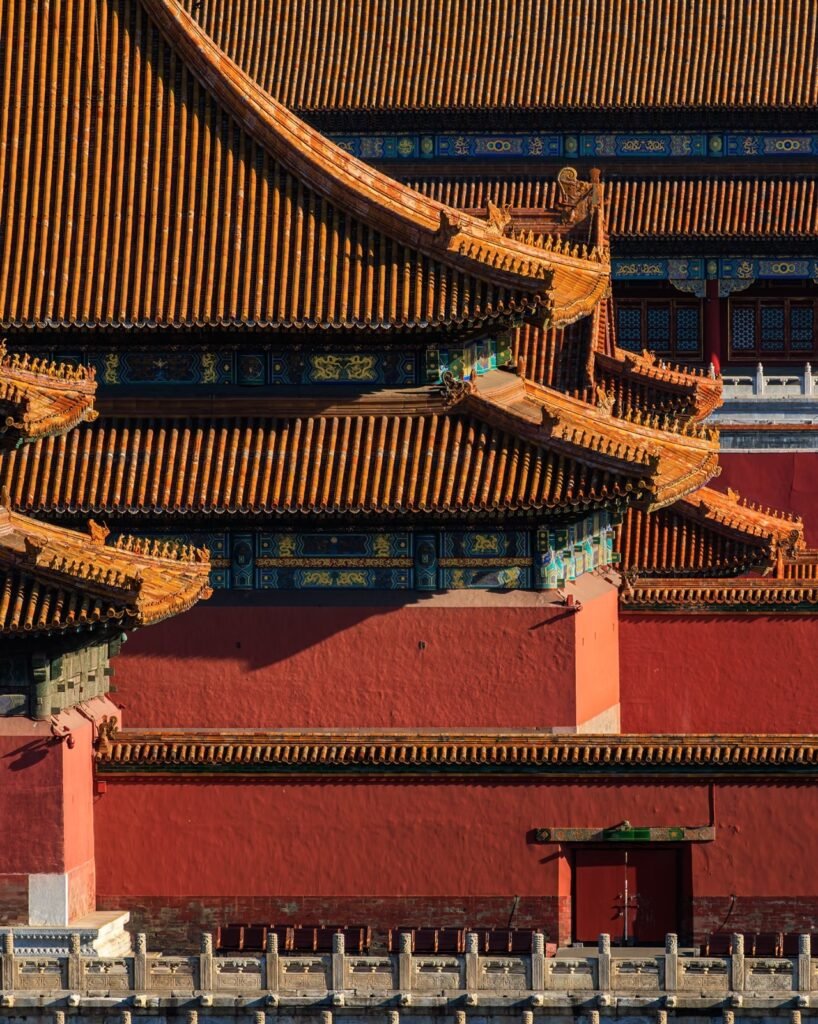
- The Forbidden City: Does the Emperor’s Home Really Have 9,999½ Rooms? Perfect for First-Time Visitors to Beijing (Suggested visit time: 4-6 hours)
- Jingshan Park: The Best View over the Forbidden City (Suggested visit time: 1 hour)
- Temple of Heaven: A 600-Year-Old Imperial Sanctuary Where Emperors Prayed to Heaven, Ideal for Anyone Who Wants to See Local Life and Ancient Beliefs (Suggested visit time: 2 hours)
- Summer Palace: The Imperial Garden Made for Slow Walks Among Lakes and Hills (Suggested visit time: 3-4 hours)
- An Underrated Gem of Chinese Architecture: The Ancestral Temple Where Emperors Honored Their Ancestors, a Must for Anyone Interested in Chinese Architecture (Suggested visit time: 1 hour)
- Lama Temple (Yonghegong): Beijing’s Busiest Temple, Home to an 18-Meter Wooden Buddha (Suggested visit time: 1.5-2 hours)
- Beihai Park: Imperial Families Knew How to Live. Don’t Miss the White Pagoda and the Glazed Tile Pavilion, Perfect for Slow Wandering (Suggested visit time: 1.5-2 hours)
Explore the Emperor’s Home: The Forbidden City
My first visit to the Forbidden City was in late November. The wind was blowing, the cold was biting, and I was so frozen that I never even made it past the first hall before rushing off to find somewhere warm. I went back in autumn, the best season to travel in Beijing, and finally took my time exploring this center of imperial power, said to have 9,999½ rooms.
The Forbidden City is the largest and best-preserved ancient wooden palace complex in the world. The red walls and yellow roof tiles are striking, and the perfectly symmetrical layout is deeply satisfying to look at.
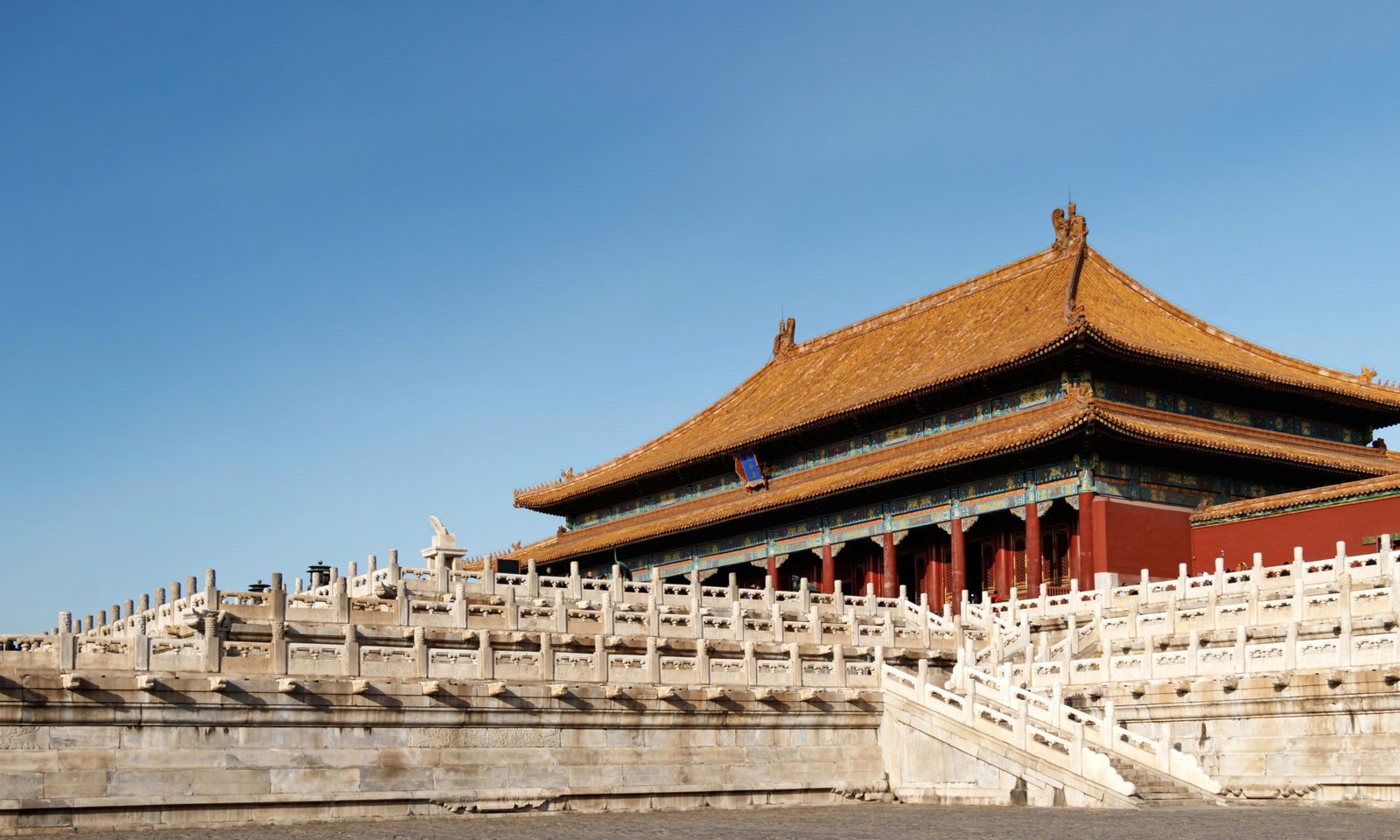
Enter through the Meridian Gate and pass through the gateway, and the space suddenly opens up. A vast courtyard stretches out in front of you, so wide that you feel tiny. At the far end, the Hall of Supreme Harmony sits on its white marble terrace, its golden glazed roof blazing in the sun. It is the southernmost of the three great outer halls, and the largest and tallest hall in the palace. Grand ceremonies such as an emperor’s enthronement and the appointment of an empress took place here, which is why it stands for imperial power. Centuries ago, officials crossed this same courtyard step by step, looking up toward the throne.
Visiting the Forbidden City is not only about the architecture and layout. For more than 600 years, the palace has been known for its drainage: the slope of the ground and rows of dragon-head spouts carry rainwater away quickly. They say that however hard it rains, the palace never floods.
It is worth listening to the stories as you walk. Twenty-four emperors lived here over 600 years, and the lives of the emperors and their consorts are even more interesting than the buildings. If you like, you can try counting whether there really are 9,999½ rooms. Just kidding: there are about 8,704. If a person spent one night in each room, starting from birth, they would be almost 24 years old before they finished.


Ticket
Foreign visitors can buy tickets in person at the ticket window at the Meridian Gate by showing their original passport. No advance reservation is needed.
All tickets are real-name. You must bring your original passport. A photo or digital copy will not be accepted.
Prices: 60 yuan per person from April 1 to October 31, and 40 yuan from November 1 to March 31. The Treasure Gallery and the Clock and Watch Gallery cost 10 yuan each and are well worth it. Buy them together with your main ticket.
Closed on Mondays (except national holidays), so plan around it.
Getting There and Security
You must enter through the Meridian Gate (south). The Gate of Divine Prowess (north) and the East Glorious Gate are exits only. Do not take a taxi to the north gate, or you will have a long walk around.
Get there Take Metro Line 1 to Tiananmen East Station and leave by Exit B, then walk to the Meridian Gate. There is a security check before you enter, and foreign visitors may have their passports checked, so keep yours ready.
Security tips: Large suitcases are not allowed in. Backpacks and small bags are fine. Tripods and selfie sticks are banned in most halls, and eating and drinking are not allowed in indoor exhibition halls.
Climb Jingshan for a View over Beijing’s Central Axis
Walk out of the Forbidden City by its north gate, cross the street, and you are at Jingshan Park. I really recommend a visit. Inside the Forbidden City you only see one hall after another in front of you, but from the top of Jingshan you can finally see how they fit together as a whole.
Jingshan has five pavilions, and the one in the middle, and the highest, is Wanchun Pavilion. This one pavilion is all you need. Stand inside it and look south, and the whole Forbidden City is spread out before you: layer upon layer of golden roofs, lined up along one straight line all the way to Tiananmen. Turn around and look north, and you will see the Bell and Drum Towers. To the west, the White Pagoda of Beihai rises beside its lake. This straight line running from north to south is Beijing’s Central Axis, and the Forbidden City is only its heaviest section. In front of the pavilion there is also a marker for the “center of Beijing,” so be sure to look for it.
Come in the morning for clear views and the best photos of the whole palace. Come in the late afternoon and you can wait for sunset, watching the golden roofs slowly darken as the lights come on one by one. The lights are not on every night, and a clear day is best.
My tip: the best way to do it is to visit the Forbidden City in the morning, leave by the north gate and go straight up Jingshan, so the route you just walked replays right in front of you. The pavilion is small, so expect a queue for photos when it is busy.
Who it’s for: anyone who wants to see the whole Forbidden City from above, and anyone who loves photography. If the weather is bad, skip it, because the view will not be worth it.
Ticket: Price 2 yuan
When:April 1 to October 31: 6:00 to 21:00 (last entry 20:30). November 1 to March 31: 6:30 to 20:00 (last entry 19:30)
Getting there: When you leave the Forbidden City by the north gate, Jingshan is right across the street. There is no need to make a special trip. Just stop by after your Forbidden City visit.

A 600-Year-Old Imperial Sanctuary: The Temple of Heaven
The Temple of Heaven is my favorite park in Beijing. I call it a park because I often go just for the ancient cypress forest, and I call it an imperial sanctuary because it was where the Ming and Qing emperors worshipped Heaven and prayed for good harvests. It has stood here quietly for 600 years. It covers more than 2.7 million square meters, bigger than the Forbidden City, yet walking in, you never feel pressed down. You just feel how wide the sky is.
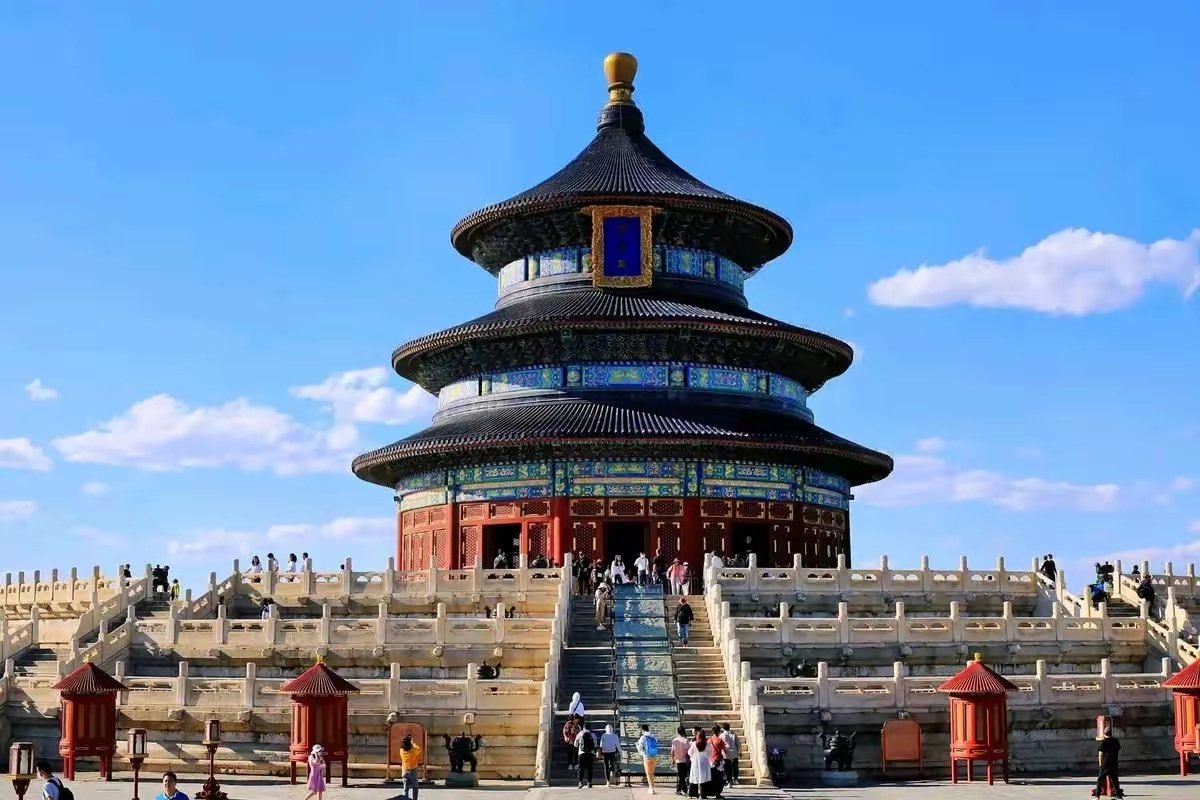
From a distance, its colors are restrained: red walls, blue roof tiles, old cypresses, and a stretch of sky. I first came to see the Hall of Prayer for Good Harvests. On later visits I often skipped the hall and just walked under the trees, and the afternoon would be gone before I knew it.
It does not feel like an attraction so much as Beijing’s backyard. Someone sings in the shade, someone plays cards in the long corridor, and others move through tai chi at an easy pace. The old rituals of worshipping Heaven and everyday life sit side by side.
The Hall of Prayer is the symbol of the Temple of Heaven. Its blue round roof rises tier after tier against the cypresses and the sky. The 28 pillars inside have meanings, too: the four central Dragon Well pillars stand for the four seasons, the middle ring of 12 for the 12 months, and the outer ring of 12 for the 12 traditional double-hours. The two rings make 24, the number of solar terms, and with the four central pillars you get 28, the number of lunar mansions. The builders were not just putting up a hall. They were writing a manual about the sky in wood.
Follow the central axis south to the Circular Mound, a three-tiered round terrace of white stone, where the emperor worshipped Heaven on the winter solstice. Stand on the round stone in the very center and there is nothing around you, only sky overhead. I like to look down and count the paving stones: nine in the first ring, 18 in the second, nine more with every ring, until the ninth ring holds exactly 81. The three tiers measure 9, 15 and 21 zhang across, which add up to 45, or nine times five, standing for the “Nine-Five” of imperial supremacy. You do not need to understand every number. Just stand there for a while, and you will feel how deeply the ancients revered Heaven.
My tips
Buy the combo ticket. With only the entry ticket, you cannot enter the Hall of Prayer, the Echo Wall or the Circular Mound. The core area is closed on Mondays, so do not make a wasted trip.
For the night view, pick a Friday, Saturday or major holiday evening. Night visits only need the entry ticket, because the core halls are closed after dark.
You can no longer press your face to the Echo Wall and shout, so please follow the park’s rules.
Do not trust unofficial guides who approach you at the gate.
Who it’s for: anyone who wants to see local life in Beijing, learn about ancient beliefs, or simply enjoy a quiet walk. If you have no interest in the ritual of worshipping Heaven and do not like walking, the Temple of Heaven can feel empty.
When:Park gates: April 1 to October 31, 6:00 to 22:00; November 1 to March 31, 6:30 to 22:00
Core area (Hall of Prayer, Echo Wall, Circular Mound): 8:00 to 17:30 in high season and 8:00 to 17:00 in low season; closed on Mondays (except national holidays)
Admission: High season: entry ticket 15 yuan, combo ticket 34 yuan. Low season: entry ticket 10 yuan, combo ticket 28 yuan
Night lighting: Only on Friday and Saturday evenings and major holidays. In summer, lights go on around 19:00 and off at 21:00
Getting there: Metro Line 5 to Tiantan East Gate Station (near the east gate), or Line 8 to Tianqiao Station. Parking is limited, so take the metro on holidays

Stroll Through Empress Dowager Cixi’s Backyard: The Summer Palace
The Summer Palace is the largest surviving imperial garden in China, covering about 290 hectares, three-quarters of it water. It sets Longevity Hill and Kunming Lake side by side and lets you wander slowly along the shore. There are flowers in spring, lotus in summer, a blaze of color in autumn, and ice on the lake in winter. Every season has its own look.
The garden was begun in 1750 by the Qianlong Emperor, to celebrate his mother’s birthday and to improve the water management around the capital. War damaged it more than once. After Empress Dowager Cixi rebuilt it and renamed it the Summer Palace, she used it as a place to rest and escape the summer heat, which is why people often call it Cixi’s backyard.
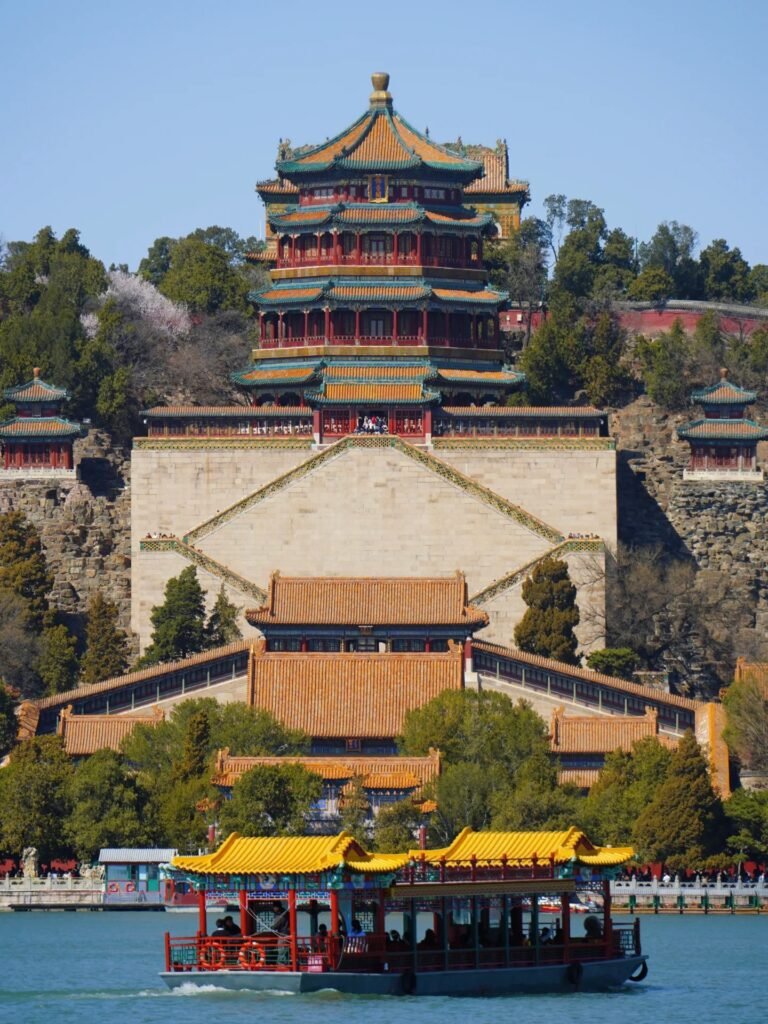
There are a few sights you should not miss. First is the Tower of Buddhist Incense. It sits halfway up Longevity Hill, the highest point in the park and the symbol of the Summer Palace. The climb has quite a few steps, but at the top the whole of Kunming Lake spreads out below you, the water wide open and the outline of the Western Hills in the distance. Just standing there makes it worth spending most of a day here.
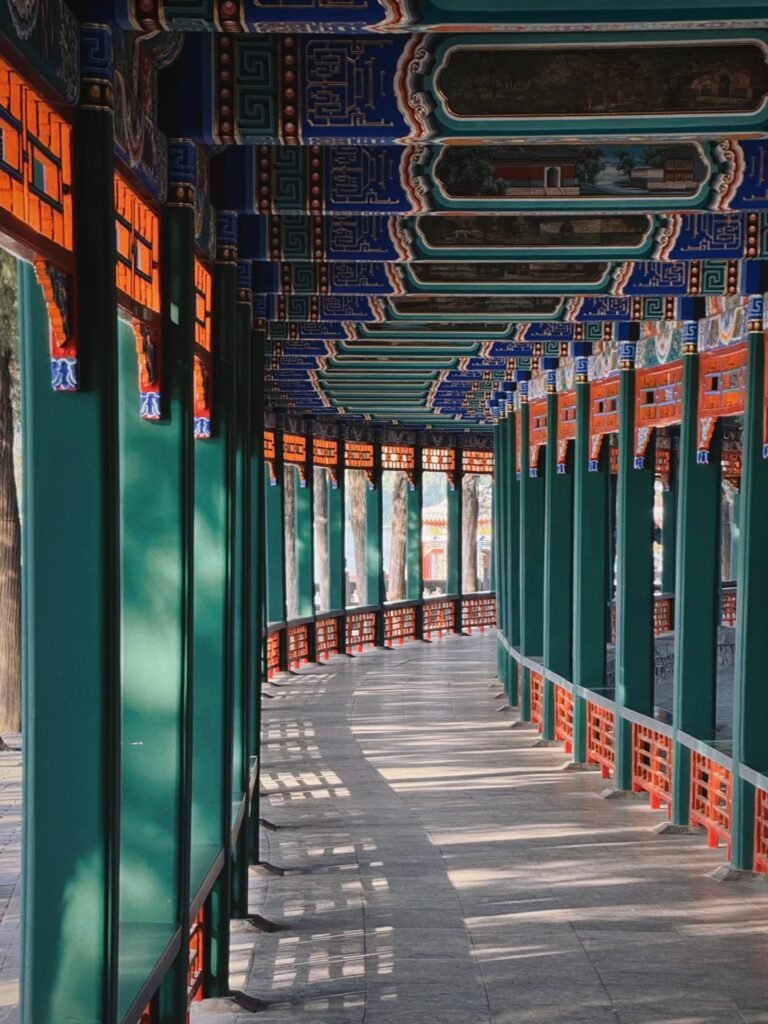
Once you are back down, follow the lake into the Long Corridor. It runs 728 meters, with more than ten thousand paintings on its beams, including stories from classics like Romance of the Three Kingdoms and Journey to the West. The lake is on one side and the hill on the other, so you can walk slowly with your head tilted up at the paintings, and rain is no problem.
I save the Seventeen-Arch Bridge for last, because it is simply too beautiful at sunset. This white stone bridge stretches 150 meters across the lake, and its railings carry 544 stone lions, said to all have different poses, if you feel like looking closely. In the evening, when the sun slides through the arches, the water and the bridge turn gold, the best moment for photos. If you have time, I recommend a boat on Kunming Lake. Looking back at the Tower of Buddhist Incense from the water is a completely different view.

My tips
Pick the right entrance: Do not enter by the East Palace Gate. It is crowded with tour groups, and everything past it is uphill. I recommend the North Palace Gate or the North Ruyi Gate, which are quieter and easier on your legs.
Wear the right shoes: You will walk at least 15,000 steps, over stone paths and slopes. Wear soft-soled sneakers, never high heels or thin-soled flats.
Think twice about the combo ticket on Mondays: The gardens within the garden, such as the Tower of Buddhist Incense area and Suzhou Street, are closed on Mondays, so a combo ticket would be wasted. The entry ticket is enough.
Getting There
Metro: The best option is Line 4 to Beigongmen Station, Exit D, then a 5-minute walk to the North Palace Gate. Or take Line 4 or 16 to Xiyuan Station, Exit C2, then walk about 10 minutes to the East Palace Gate.
Bus: Routes 303, 332, 331, 346 and 584 reach the East or North Palace Gate. Routes 74, 374 and 437 reach the New Palace Gate.
An Underrated Gem of Chinese Architecture: The Ancestral Temple
The Ancestral Temple stands right beside the Forbidden City. You pass its wall on the way to the Meridian Gate, yet many people overlook it and head straight into the palace. It is a real shame.
This was where the Ming and Qing emperors honored their ancestors, and it was built in 1420, around the same time as the Forbidden City. The ancients followed the principle of “ancestors on the left, altar of the land and grain on the right,” so the ancestral temple lies east of Tiananmen and the altar to the west, which is now Zhongshan Park. The grounds are larger than you might expect, nearly 200,000 square meters with more than 700 ancient trees. If the Forbidden City feels grand and lively, the Ancestral Temple feels quiet and solemn. Walk into the cypress grove and the noise of the crowds fades, and your footsteps become clear.
The highlight is the main hall, where the emperors held their great ancestral ceremonies. It stands on a three-tiered white marble terrace, under a yellow double-eaved roof, and at eleven bays wide it matches the scale of the Hall of Supreme Harmony in the Forbidden City. Step inside and the pillars hit you first: 68 massive golden nanmu columns, said to be single trunks, the tallest more than ten meters, so you have to tilt your head back to see them. Look higher and the beams are painted in gold. Underfoot are “golden bricks,” a type of floor tile that is said to ring like metal when tapped. In the Forbidden City’s halls, the crowds make it hard to stand still and look. Here you can stop and gaze upward for a while, a feeling modern buildings rarely give you.
You do not need to look closely at the other halls. Beyond the main hall are the sleeping hall and the rear hall, where the ancestral tablets were kept. A quick look is enough.


My tips:
The smoothest plan is to pair it with the Forbidden City: take the metro to Tiananmen East Station, enter by the east gate of the Working People’s Cultural Palace, walk to the Ancestral Temple’s south gate, and when you finish, walk straight to the Meridian Gate.
The temple sits inside the Working People’s Cultural Palace. Do not mistake it for an ordinary park and walk past.
If you love old architecture, spend an hour slowly studying the beams and ceiling of the main hall. It is worth more than rushing through ten halls.
The ancient building area (the main hall) is closed on Mondays, so do not make a wasted trip.
Who it’s for: anyone who loves ancient architecture or wants a quiet corner. If you want exhibits and lively scenes, or you only have half a day, put the Forbidden City first.
Where: East Chang’an Avenue, east of Tiananmen, Dongcheng District, Beijing (inside the Working People’s Cultural Palace)
Admission: The park entry ticket is 2 yuan, bought on site by QR code or at the window, with no reservation needed. Entering the main hall (the “Zhonghua Hezhong” exhibition) requires a separate ticket: 15 yuan in high season (April to October) and 10 yuan in low season (November to March)
When:Park: High season (April to October) 6:30 to 20:00 (last entry 19:30); low season (November to March) 7:00 to 18:00 (last entry 17:30)
Ancient building area (main hall): 9:00 to 17:00, closed on Mondays (except national holidays)
Getting there: Metro Line 1 to Tiananmen East Station, Exit B, then walk about 400 meters north along Nanchizi Street to the east gate, about 8 minutes

Lama Temple (Yonghegong): Beijing’s Busiest Imperial Temple
Before Yonghegong became a temple, it was a princely residence: the home of Prince Yong, the future Yongzheng Emperor, and the place where the Qianlong Emperor was born. That is why its roofs are covered in yellow glazed tiles, a color reserved for the imperial family and nothing like the gray tiles of an ordinary temple. Imperial grandeur and the smoke of everyday prayer in one place: that combination exists only here in Beijing.
The first thing you notice when you walk in is the smell of incense. This is the busiest temple in Beijing for incense, and whatever the hour, there is a line to light it. Perhaps everyone carries some wish in their heart: wealth, career, health, love. Since you are here, you can light three sticks of incense and tell the Buddha what you hope for. And if you want nothing for yourself, you can wish for peace in the world.
The temple holds three wood carvings known as the “Three Wonders of Woodcarving.” The first is in the Hall of the Wheel of Dharma: a mountain of 500 arhats carved from red sandalwood, layer upon layer, each arhat with a different expression. The second is in the Zhaofo Pavilion: a Buddha shrine of golden nanmu wood carved with 99 dragons, none alike. The third is in the last hall, the Wanfu Pavilion: the Maitreya Buddha, carved from a single trunk of white sandalwood, 18 meters above ground and another 8 meters below. Inside, you have to tilt your head back as far as it will go to see the Buddha’s face, and you feel very small.


My tips
Go on a weekday morning, when it is least crowded.
Photography is usually not allowed inside the halls, so look out for signs.
Spring Festival and holidays are extremely crowded, so avoid them if you can.
This is a place of worship. Do not point at the statues.
You can pick up free incense at both sides of the entrance, one bundle per person. There is no need to buy incense from the stalls outside.
Incense etiquette: if your incense flares up after lighting, gently fan it out with your hand. Never blow it out with your mouth. Incense may only be burned in the censers outside the halls, and it is strictly forbidden to bring it into any hall.
Tickets : You can buy tickets on arrival. Admission is 25 yuan per person.
ID requirements: Bring your original passport and buy your ticket at the ticket window or at a self-service machine that accepts foreign ID.
Online reservation (backup): If you are traveling with a Chinese friend, they can reserve through the “Yonghegong Visitor and Worshipper Service” WeChat official account using your passport details, and you enter by scanning your passport or a QR code.
When: April to October, 9:00 to 17:00 (last entry 16:30). November to March, 9:00 to 16:30 (last entry 16:00).
Getting there: Metro Line 2 or Line 5 to Yonghegong Lama Temple Station, Exit F, then a 2 to 3 minute walk (the best option).

Imperial Garden: Beihai Park
Beihai Park is an 800-year-old imperial garden, and the oldest and best-preserved imperial garden in China. The Liao, Jin, Yuan, Ming and Qing dynasties all worked on this garden.
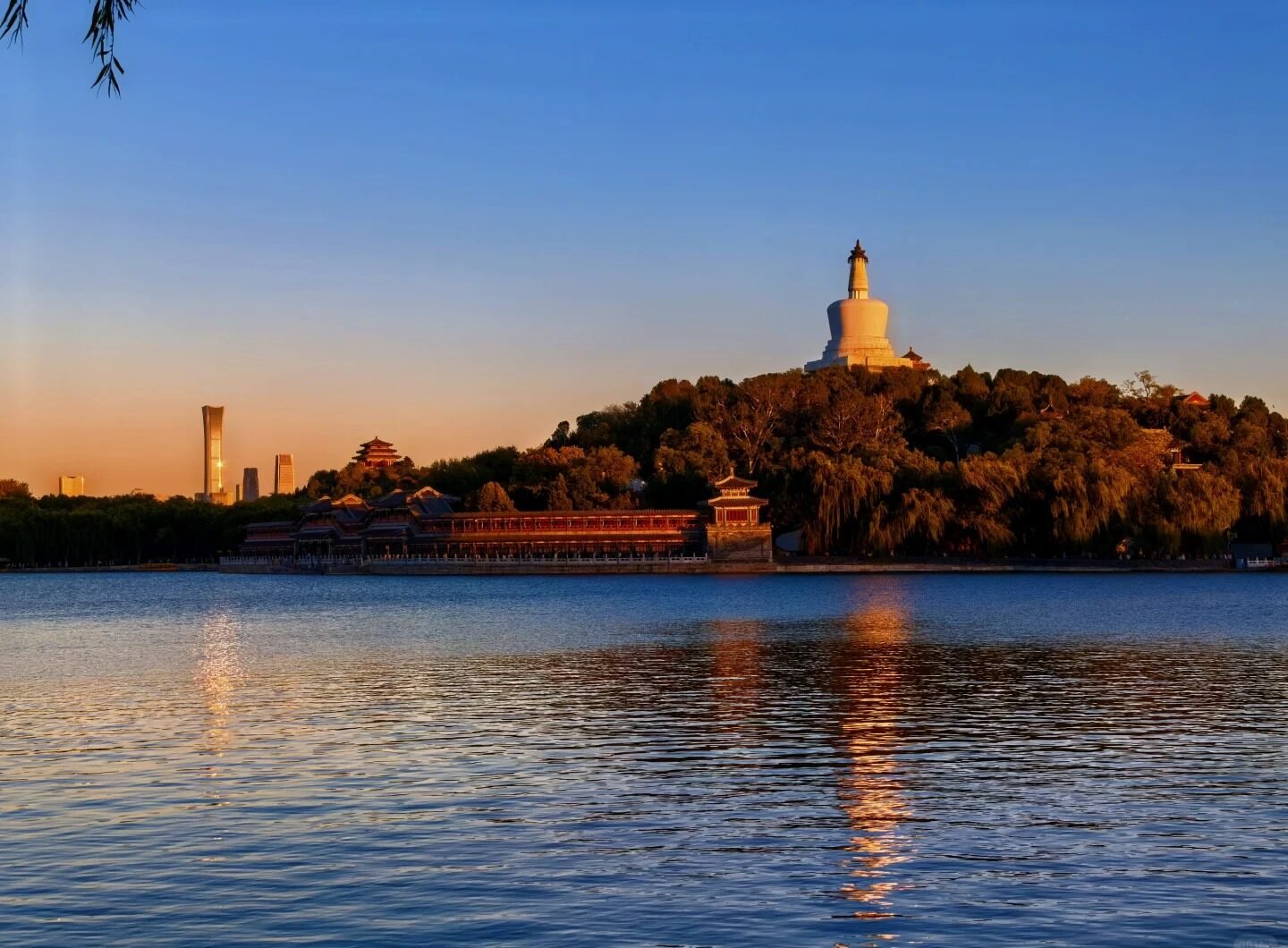
More than half of Beihai is water. In summer the lake is full of lotus, and you can rent a boat, row slowly to the middle, and look back to see the White Pagoda reflected in the water. In winter the lake freezes over, and it is said that the Qianlong Emperor even watched ice games here with his mother.
The White Pagoda stands on Qionghua Island in the middle of the lake. It was built in 1651, under the Shunzhi Emperor, and is the symbol of Beihai. The climb is not tiring, and from the top you see the lake, the red walls, and the golden roofs of the Forbidden City.
For me, Beihai’s real surprise is the Glazed Tile Pavilion (Liuli Ge). It sits in a courtyard compound called Xitian Fanjing in the northwest corner of the park. It was built in 1759 and is one of the finest surviving Qing dynasty glazed-tile buildings, covered in glazed tile all over. The courtyard only opened to visitors on September 29, 2026, after being closed for more than 70 years.
Beihai is perfect for a slow, unhurried wander. Find a spot by the lake, sit down, and enjoy the quiet.
My tips
Beihai is large. The entry ticket is enough, and you will still spend 2 to 3 hours here. There is no need for the combo ticket unless you really want to enter the gardens within the garden.
Some of the gardens within the garden close on Mondays (except national holidays), and courtyards such as the Glazed Tile Pavilion are also closed on Mondays.
Ticket:
Low season (November 1 to March 31): entry ticket 5 yuan, combo ticket 15 yuan
High season (April 1 to October 31): entry ticket 10 yuan, combo ticket 20 yuan
When:
Park gates: High season 6:00 to 21:00 (last entry 20:30); low season 6:30 to 20:00 (last entry 19:30)
Gardens within the garden (White Pagoda, Studio of Serene Heart, etc.): High season 8:00 to 18:00; low season 8:30 to 17:00
Getting there: Metro Line 6 to Beihai North Station, Exit B or Exit D, then a short walk
How to Choose and Combine
Beijing has no shortage of imperial heritage, but there’s no need to see it all. After a few sites, they start to overlap, and it’s easy to feel like you’ve already seen everything. If your time is limited, I’d suggest prioritizing the Forbidden City, the Temple of Heaven, and the Summer Palace. Each one explores a different theme, so together they barely repeat one another, and they’re enough to give you a well-rounded picture of imperial Beijing.
Jingshan Park and the Ancestral Temple make good add-ons. Both are close to the Forbidden City, so if you happen to be nearby, drop them in, but they’re not essential.
So there’s no need to “see it all.” Pick a few well, leave time to wander, and you’ll usually get more out of it than from rushing through a checklist.
If you’d like to go deeper on a single place, start with the individual guides to the Forbidden City, the Temple of Heaven and the Summer Palace. Each one goes into more detail than there was room for here. If you’d rather do less homework, you can hire a local guide to show you around Beijing, so you can spend your time enjoying the city instead of planning it. Beyond the emperors’ palaces, make time for the hutongs too: narrow lanes, courtyard homes and neighbors who have lived there for generations. It’s a quieter, more human Beijing, and a good counterweight to all that imperial grandeur.Explore more in Local Beijing
BEIJING-HUTONG
MUTIANYU GREAT WALL
HONGKONG
SHAOLIN TEMPLE
XI'AN
QINGDAO
SUZHOU
HOME
ABOUT
DESTINATION
TRAVEL GUIDE

Get the occasional email from TripExpect — things worth knowing before or during your trip.
© 2026 TripExpectJouney All Rights Reserved
