
Spend an Afternoon in a Chengdu Teahouse
Before I went to Chengdu, everything I knew about the city fit into two words: pandas and hotpot. That was it. That was my whole mental picture. So I was not even a little prepared for the thing that actually stuck with me most — the teahouse culture. It turns out this city has quietly built an entire way of life around sitting still, and for someone who’s always been drawn to slow travel, it felt like it was designed for me specifically.

I did some scrolling before I went, trying to figure out which teahouse was “the one.” There are dozens of options in Chengdu, and a lot of the newer ones are clearly built for photos — perfect lighting, curated snacks, the whole aesthetic package. I skipped those. I wanted somewhere with actual history, somewhere locals had been going for decades, not somewhere that opened last year with a hashtag in mind.
That’s how I landed on Heming Teahouse inside People’s Park. It’s the classic choice for a reason — it’s been around since the 1920s, it sits right on a lake under a canopy of old trees, and it’s where generations of Chengdu retirees have shown up to play cards, chat, and get their ears cleaned. I wanted the real version of this experience, not a staged one, and Heming seemed like the safest bet for that.
You can take Metro Line 2 to People’s Park Station, Exit B, which drops you pretty much right at the park entrance — the easy, foolproof option.
I actually biked over from Chunxi Road, which took about 20 minutes, and my map routed me in through a back entrance that cuts through a local wet market. I wasn’t expecting that, but it turned out to be my favorite part of the whole trip there — vendors setting up, people doing their morning grocery run, that unmistakable feel of a neighborhood just going about its day. It didn’t feel staged for tourists at all, because it wasn’t. Once you’re inside the park, there are signs pointing toward the teahouse, so you really can’t get lost — just follow them in.
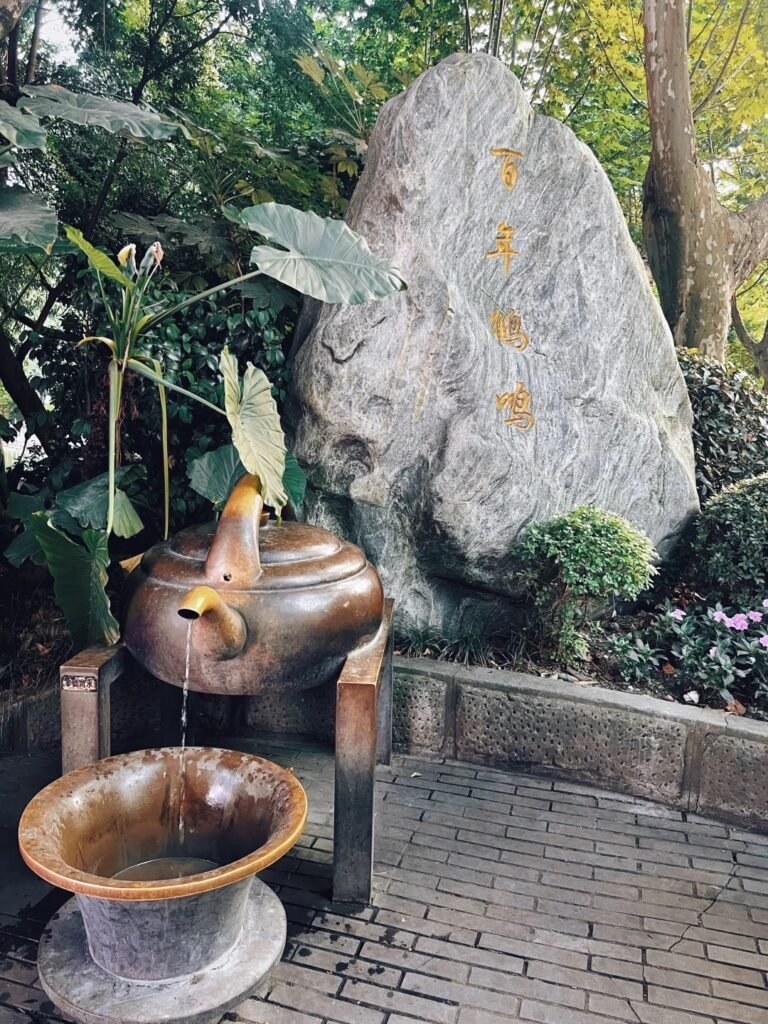
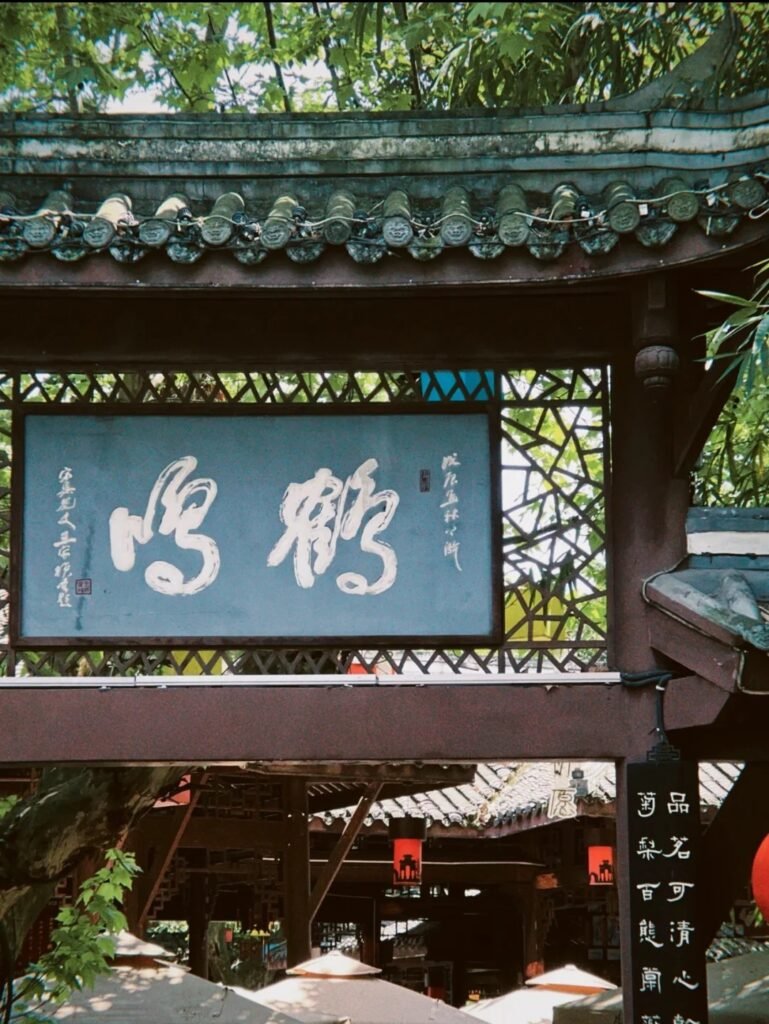
I got to Heming around 10:30am, and by then, every seat along the lake was already taken. If a lakeside spot is what you want, you’ll need to show up before 9am — Chengdu’s retirees are early risers and they claim those seats fast. The lakeside tables get a bit of sun, but you get an open view of the water and a little more breathing room from the crowd, which some people prefer.
We ended up in the middle section instead, in the thick of things, and honestly it was just as good in a different way — shaded, cooler, but packed in close enough with neighboring tables .
While I was there, I ended up chatting with a Malaysian family who’d made a special trip to the park just to experience morning tea, the same way I had. That, more than anything, told me something about Chengdu — this is a city genuinely full of international visitors who’ve done their homework, not just people passing through on a panda-and-hotpot itinerary.
The tea here is gaiwan-style — served in a lidded bowl rather than a cup — and prices run about 18 to 35 RMB depending on the leaf you choose. Once you order, they set a hot water kettle right beside your table, so you can refill it yourself as many times as you want for as long as you’re sitting there.
Right next to Heming is Zhong Shuijiao (钟水饺), another old, well-known local brand, and you can actually order their food straight from your teahouse seat and have it brought over — though if you want it to arrive faster, it’s better to walk over and order in person. We got their popular combo set, which gives you a small taste of several different dishes at once — it photographs beautifully, and the dumplings and noodles were genuinely good, not just Instagram bait.
There’s also an intangible-heritage gongfu tea pouring performance that happens periodically around the teahouse — the kind with the long-spouted kettle poured from a dramatic height. Honestly, I didn’t feel the need to pay for it myself, but you don’t have to. Whenever someone nearby ordered it, I just leaned over and watched from my own table, which felt like exactly the right amount of participation.
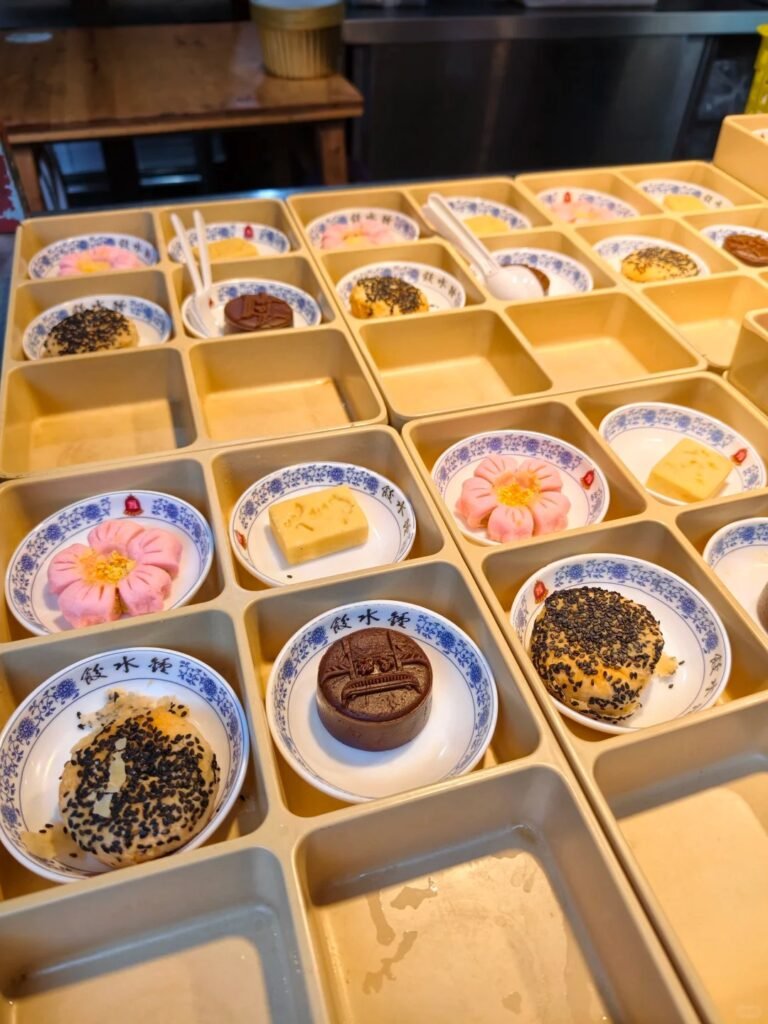
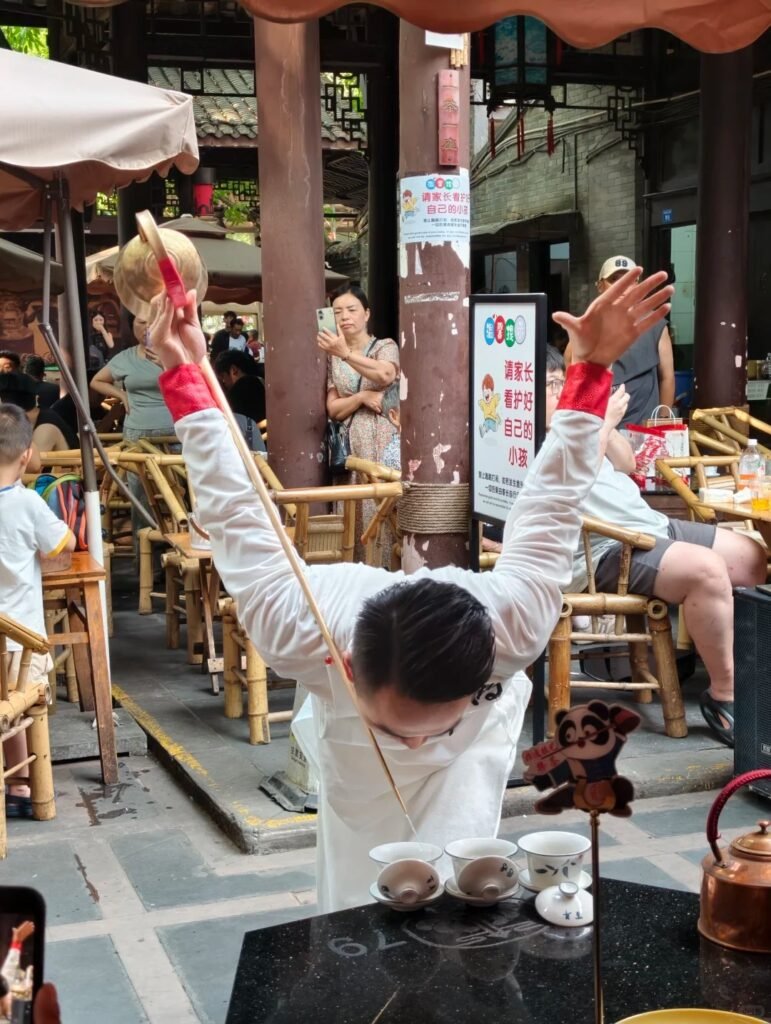
Mostly I just sat there — watching the cards, listening to the mahjong tiles, feeling my tea go from too-hot to just-right to slightly-too-cool and getting refilled again. At some point I stopped checking my phone entirely. That’s when I knew I’d actually gotten it — the whole point of the teahouse isn’t the tea. It’s having permission to just exist somewhere, publicly, with no task attached to it.
A Few Practical Things I Learned
Get there before 9am if a lakeside seat matters to you — otherwise, the middle section is a completely solid backup, just be ready to talk a little louder.
If ear cleaning isn’t your thing, that’s completely fine — plenty of people just sit, drink tea, and watch the room, and nobody bats an eye either way. Same goes for the gongfu tea performance — you can enjoy it for free just by sitting near a table that ordered it.
I’d budget at least two hours, honestly. If you only have 30 minutes, I’d skip it and come back another day, because the whole appeal is in not rushing.
More Stories

Join us
Get the occasional email from TripExpect — things worth knowing before or during your trip.
BEIJING-HUTONG
MUTIANYU GREAT WALL

HONGKONG
SHAOLIN TEMPLE
XI'AN

QINGDAO
SUZHOU

© 2026 TripExpectJouney All Rights Reserved
